Howitt Primary Community School

Early Years Foundation Stage

2 year funding
To check if you are eligible for the free 15 hours and apply, visit
- http://www.derbyshire.gov.uk/freechildcare or
- text Child to 86555 and get a call back or
- call 01629 539316 or 01629 539319 (9am to 5pm weekdays)
2 year old sessions available
Places are available for morning or afternoon sessions in our Rhyme room, the sessions available are 8:45am-11:45am or 12:15pm to 3:15pm.
If you wish to book a visit or require any more information please phone Nicola Gregg Early Years Co-ordinator or Debbie Walker on 01773 713217
30 hour funding for 3 and 4 year olds
If you are eligible for the 30 hour free funding you can apply for a full time place in our nursery.
You can check if you are eligible by logging on to: www.childcarechoices.gov.uk
and then follow the links on the screen. Once you have your eligibility code please bring it in to school and you can fill in your session choices.
If you need any more information please phone 01773 713217 for further help and advice.
Nursery sessions available

Morning session 8:30-11:30am
Afternoon session 12:30-3:30pm
All day session 8:30-3:30pm (please bring your own lunch)
Extra sessions are available at a cost of £4.00 per hour

Reception
If you would like a place for your child to start in our reception at Howitt Primary School please apply for a place using the following link:
https://www.derbyshire.gov.uk/education/schools/school-places/apply-for-a-school-place.aspx
Visits to the school are warmly welcomed please call the school office on 01773 713217.
Breakfast club is available from 7.30 am at a cost of £4.50 a day or £18.00 a week
Evening Owls is available until 6pm every day at a cost of £9.00 per night
EYFS Brochure
Nursery Leaflet


Rhyme Room Leaflet


Intent
At Howitt Primary Community School, we provide a high-quality EYFS education giving children a secure and confident start to their school life. We are committed to nurturing a lifelong love of learning alongside the aims of the EYFS statutory framework.
We strive for high standards, consider the development of the whole child and seek to foster resilience and independence. We endeavour to emotionally prepare the children for the challenges in KS1, giving them a secure foundation as they move through the school.
We aim to provide the essential knowledge and skills that children need to prepare them for their future success and to give children the best possible start to their early education.
Our inviting classroom environments indoors and outdoors stimulate learners and engage them in developing the three ‘Characteristics of Effective Learning’ as set out within the EYFS.
The EYFS curriculum encompasses our school motto
Achieve, Care, Enjoy
We carefully plan our EYFS curriculum to meet the following aims:
• Foster a love of learning which inspires curiosity.
• Provide experiences of awe and wonder.
• Ensure all children have access to high quality learning opportunities.
• Provide parents/carers with the opportunity to develop their child’s learning at home.
• Develop knowledge and understanding of the community and wider world.
Implementation
• Quality first teaching across all areas of the curriculum.
- Stimulating learning environments indoors and outdoors.
- Well planned and organised continuous provision which allows the children to learn through play.
- A carefully planned balance of adult-led and child-initiated learning opportunities.
- We promote a love of learning through real life experiences and opportunities to build on prior learning.
- Close links with local nurseries which support a smooth and settled transition into school.
- Strong parental partnerships which empower parents to support their child’s learning at home.
- Systematic approaches to teaching reading to ensure all children learn to read. High quality phonics teaching is started as soon as children begin reception.
- Opportunities for children and families to develop a love of reading.
Impact
- High levels of engagement and motivation demonstrated from children which supports them to become lifelong learners.
- Confident and capable readers who demonstrate a love of reading.
- Evidence of strong links with parents.
- Children demonstrate the characteristics of effective learning and are well prepared for the next stage in their learning.
- Children feel happy and safe and enjoy coming to school.
- All children access a balanced and challenging curriculum regardless of their background, needs or abilities.
- Children make strong progress from their starting points and are offered a broad curriculum which meets each child’s unique needs.
- Children are supported by adults that are well trained and passionate about providing the best education for every child.
- The percentage of children achieving the GLD within the EYFSP is in line with or above the national average.
Learning in the EYFS
Play, Scaffolding, Modelling, Observing, Guided Learning, Direct Teaching
In our classroom, you may see children playing alone or with their peers, deciding on resources and choosing how to spend their time. You may see a child playing and listening to an adult, who is modelling how to achieve something or teaching a new skill that interests the child. Adults may scaffold a child’s play. This involves taking their play to higher levels of learning, entering the play as a co-creator and helping to provoke a framework for the children to go from “what they know” to “what else they could know”. Scaffolding enables a child to solve a problem, carry out a task or achieve a goal which is just beyond his or her abilities. During play, where foundational social and emotional skills are developed, scaffolding is a bridge to new skill levels using three key ingredients; modelling the skill, giving clues and asking questions while the child is trying out a new skill, and then as the child approaches mastery, withdrawing the support.
The EYFS statutory framework does not prescribe a particular teaching approach.
“Play is essential for children’s development, building their confidence as they learn to explore, relate to others, set their own goals and solve problems. Children learn by leading their own play, and by taking part in play which is guided by adults.”
At Howitt Primary Community School, the EYFS team carefully plans what the children learn in the classroom and through provision enables them to learn from their interests, alongside extending their knowledge and understanding through direct teaching. Each day, we stimulate children’s interests, respond to each child’s emerging needs and guide their development through warm, positive interactions coupled with secure routines for play and learning. As the children develop and their skills progress throughout the reception year, we use more direct teaching and modelling and plan specific sequences of lessons. These strategies help us to focus on teaching the essential skills and knowledge in the specific areas of learning so that the children can develop the skills and confidence required for the end of their reception year.
Key Features of Effective Practice
The best for every child
At Howitt Primary Community School children will be given an equal chance of success.
• We ensure that all children have access to high-quality early education. We pay particular attention to those children from disadvantaged backgrounds to ensure we can ‘narrow the gap’.
• We provide high-quality early education and care which is inclusive for all children. Children’s special educational needs and disabilities (SEND) are identified quickly. All children promptly receive any extra help they need, so they can progress well in their learning.
High-quality care
Our practitioners ensure the children’s experience is the central focus of thinking.
• We ensure our young children are well cared for to enable them to thrive.
• High-quality care is consistent. All practitioners enjoy spending time with young children and this is reflected in their interactions with children.
• Practitioners are responsive to children and ensure they form effective and positive relationships with all children.
• Practitioners support children to develop their independence.
The curriculum
The curriculum is well planned to ensure we identify ‘what we want the children to learn'. It is inclusive of the Educational Programmes set out in the EYFS Statutory Framework. We carefully plan our EYFS curriculum to focus on the children’s needs and interests and inclusive of the 7 Areas of Learning. The Early Years curriculum is designed to give children the foundational knowledge and understanding they will need for key stage 1 and for the rest of their schooling. The curriculum provides the essential knowledge and skills that children need to prepare them for their future success and to give children the best possible start to their early education. We stimulate learners and engage them in developing the three ‘Characteristics of Effective Learning’ as set out within the EYFS.
Pedagogy
- Every child is enabled to make progress in their learning, with the right help.
- We utilise different approaches to learning to ensure all children make progress. Children learn through play, by adults modelling, by observing each other, and through guided learning and direct teaching.
- Practitioners carefully organise enabling environments for high-quality play.
- Children in our early years also learn through group work, when practitioners guide their learning.
- As the children develop throughout the year they are given more guided learning.
- We have a well-planned learning environment, indoors and outdoors.
Assessment
- Assessments are completed to inform planning and support the practitioners in identifying children who need additional support.
- Assessment is based upon a secure knowledge of child development.
- Practitioners have a clear expectation about what children need to know and how best to support them in developing their learning.
- Accurate assessment is used to highlight whether a child has a special educational need or needs extra help.
- The EYFS lead works alongside other leads within the Embark Academy Trust to moderate across each EYFS year groups. Moderation enables all teachers within the EYFS to develop and apply a consistent and precise language of assessment that can be used across the trust.
Self-regulation
As part of our ‘Personal, Social, Emotional Development’ teaching provision we support each child’s ability to:
- hold information in mind,
- focus their attention,
- think flexibly,
- inhibit impulsive behaviour.
- These abilities contribute to the child’s growing ability to self-regulate:
- concentrate their thinking,
- plan what to do next,
- monitor what they are doing and adapt,
- regulate strong feelings,
- be patient for what they want,
- bounce back when things get difficult.
Partnership with parents
- We ensure that parents/carers have a strong and respectful partnership in the early years which enables children to thrive.
- We listen regularly to parents and give parents clear information about their children’s progress through face to face opportunities.
- Parents are encouraged to support their child’s learning and development at home as this has a significant impact on their child’s learning.
- We take the time to ‘get to know’ and understand the children and their families enabling us to offer support as needed.
- Parents/carers are invited into school for a ‘Stay and Play’ session with their child prior to starting school. This provides parents/carers with the opportunity to familiarise themselves with the classroom environment and meet other parents.
- Parents/carers are given the opportunity throughout the year to engage in the wider school community.
- Parents are invited into school for regular parents’ evenings to provide an update about their child’s learning and progress.
- Parents/carers are kept up to date with events, learning and achievement via our Google classroom pages.
- Children with SEND or additional needs have ‘shared conversations’ to ensure targets and progress are shared.
- We are flexible in our approach to communicating with parents/carers and adapt our communication methods to suit different preferences.
EYFS Statutory Framework
EYFS Principles
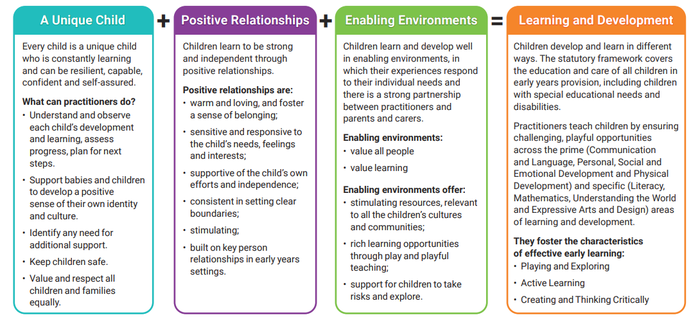
There are four overarching principles in the Early Years Foundation Stage (EYFS). Every child is unique and individual and will make progress at different rates. In order to thrive, learn and develop, they need to have opportunities to create positive relationships with others and explore environments that stimulate their curiosity. These principles underpin all aspects of teaching and learning in the Early Years Foundation Stage.
Characteristics of Effective Learning
Characteristics of Effective Learning describe behaviours children use in order to learn. To learn well, children must approach opportunities with curiosity, energy and enthusiasm. Effective learning must be meaningful to a child, so that they are able to use what they have learned and apply it in new situations. These abilities and attitudes of strong learners will support them to learn well and make good progress in all the Areas of Learning and Development.
The three characteristics of effective teaching and learning are:
• Playing and exploring – children investigate and experience things, and ‘have a go’.
• Active learning – children concentrate and keep on trying if they encounter difficulties, and enjoy achievements.
• Creating and thinking critically – children have and develop their own ideas, make links between ideas, and develop strategies for doing things.
7 Areas of Learning and Development
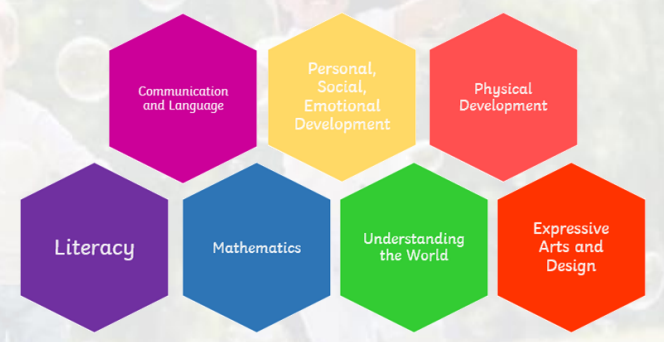
There are seven areas of learning and development that must shape educational programmes in early years settings. All areas of learning and development are important and inter-connected.
Three areas are particularly important for building a foundation for igniting children’s curiosity and enthusiasm for learning, forming relationships and thriving.
These are the prime areas:
• communication and language
• physical development
• personal, social and emotional development
Children are also supported in the four specific areas, through which the three prime areas are strengthened and applied.
The specific areas are:
• literacy
• mathematics
• understanding the world
• expressive arts and design

“Play is essential for children’s development, building their confidence as they learn to explore, relate to others, set their own goals and solve problems. Children learn by leading their own play, and by taking part in play which is guided by adults.”
(EYFS statutory framework )


